Corn Plant
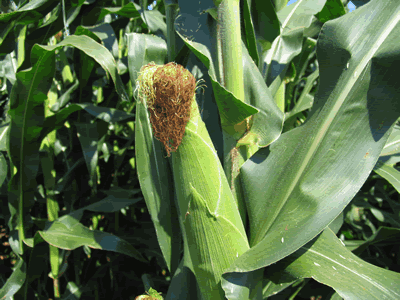
Corns plant in my farm in Kampong Thom province
1. Soil
Corns can be grown well in mud soil near
river, canal, lakes, or small rivers and volcanic red soil, volcanic
black soil, forest soil, alluvial soil, and sandy silt.
2. Weather
Corns like dry and wet weather. We can plant corns all the times in Cambodia, if we supply enough water.
3. Water
Corns need water but they don’t grow well in rainy time even though it doesn’t wet corn roots.
4. The quality of fruits
Corn is a basic food of powder and
scraps that can be made as foods, feeds, and vegetables. Its young
fruits, raw fruits, and even ripen fruits are the most favorite for
people.
5. Corn race selection
We should choose a corn with three
advantages such as good taste, high growth, and high yield. There are
three kinds of corns we should consider:
- Sticky corn: Big fruits, double heads, and soft kernels (meat) and can be grilled for food. It value in market.
- Local corn or Kouy corn: Big fruits, single head, and soft kernels (meat) and it tastes like sticky corn.
- Maize: It is a yellow corn and a new
imported race. It produces big fruits, high yield and it is easy to
plant as above races. It contain powder almost two times of white corn
that why it has tight meat. It tastes so delicious when we boil
immediately after collecting from farm. We ate a maize means we ate 2
white corns but its quality is equal to 3 white corns.
6. Place selection
We should choose a place near your house
or near a pond to plant corn or we can choose a place near river bank
or near the water source.
7. Soil preparation
The soil for corn is quite similar to
other vegetables soil preparation. First we plow soil and dry soil for
3-4 days and second we make the soil fine so that it easy to plant corns
in straight rows.
8. Seed selection
Seeds must be brought from the middle of
corncob because the top and the bottom kernels are small. The middle
kernels are flat and long and they can grow very well. We should soak
the seeds 3-4 hours before planting.
9. Planting

Young corn plant in a vegetables yard
- We can plant corn after rain in April.
If the field looks rough make sure it become smooth because some holes
are at lower or rough places corns didn’t grow out.
– If it rained in the afternoon or at night we should soak seeds immediately to plant tomorrow so that they grow well.
– We have another way to plant corns by packing the soil to insert seeds. We use dibble stick to make holes for planting corn-kernels. We don’t use sharp dibble stick, we use the wide bottom dibble stick to grow seeds well and it’s easy to take some small plants out of hole.
– We pack 4-6 cm deep depending on wet or dry soil. We pack deep for dry soils and not to deep for wet soil.
– We pack holes every 0.6 m and 0.9 m from each row. If we plant just in a row we pack only 0,3 m from hole to hole.
– We put 5-6 corn-kernels per hole by fulfilling holes with wet sandy soil or alluvial soil.
– If it rained in the afternoon or at night we should soak seeds immediately to plant tomorrow so that they grow well.
– We have another way to plant corns by packing the soil to insert seeds. We use dibble stick to make holes for planting corn-kernels. We don’t use sharp dibble stick, we use the wide bottom dibble stick to grow seeds well and it’s easy to take some small plants out of hole.
– We pack 4-6 cm deep depending on wet or dry soil. We pack deep for dry soils and not to deep for wet soil.
– We pack holes every 0.6 m and 0.9 m from each row. If we plant just in a row we pack only 0,3 m from hole to hole.
– We put 5-6 corn-kernels per hole by fulfilling holes with wet sandy soil or alluvial soil.

Corns are flowering in my farm near Stuengsen river
10. Some difficulties
- The first difficulty is that the seeds
didn’t grow well. Many holes weren’t grow by seeds because the seeds
were rotten or they couldn’t grow out, so we should over fulfill holes
by sandy soil and water them.
– Crickets cut young corn and chicken eat their sprouts. To avoid from crickets we harrow the field before planting.
– Dry soil made corn wilted and low fruits producing. To avoid this problem, we just pound their bases and cover their bases by small woods or leaves or straw.
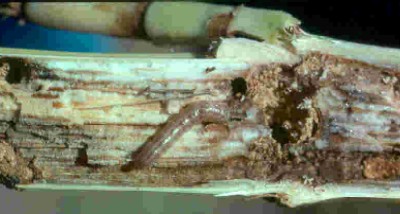
– Another difficulty of corns near river or lake is that they will be sunk by water in rainy season. Food is a natural disaster we are difficult to protect. Insects also the main problem we should pay much attention. We shouldn’t use poison to kill insect especially worms we just use wood leaves or bark as poison, it doesn’t effect to our life.
– Crickets cut young corn and chicken eat their sprouts. To avoid from crickets we harrow the field before planting.
– Dry soil made corn wilted and low fruits producing. To avoid this problem, we just pound their bases and cover their bases by small woods or leaves or straw.
– Another difficulty of corns near river or lake is that they will be sunk by water in rainy season. Food is a natural disaster we are difficult to protect. Insects also the main problem we should pay much attention. We shouldn’t use poison to kill insect especially worms we just use wood leaves or bark as poison, it doesn’t effect to our life.
11. Caring
- When corns grow 2 leaves we must pull out a small young corn.
– When they grow 3 leaves we pull out another small young corn.
– When they grow around 3-5 cm tall we must mound up their base.
– After a few days, we mound up their bases again.
– When they grow under your knee we should find out the ball stems and pull them out because they are useless. The flat stems produce many big fruits.
– When they grow to our knee tall we start mounding up on more time to get more roots growing from their stems and help them grow faster by its roots.
– When the corns were completely flowering, we should find and cut small and short young fruits stems. We can sell or eat those young fruits and corncobs.
– When the corn silk was faded we should cut the lowest two leaves and pull grasses to make the wind flow that can make corns fruits bigger and become mature faster.
– Corns produce high yield only 3-4 flat stems per clump.
– When they grow 3 leaves we pull out another small young corn.
– When they grow around 3-5 cm tall we must mound up their base.
– After a few days, we mound up their bases again.
– When they grow under your knee we should find out the ball stems and pull them out because they are useless. The flat stems produce many big fruits.
– When they grow to our knee tall we start mounding up on more time to get more roots growing from their stems and help them grow faster by its roots.
– When the corns were completely flowering, we should find and cut small and short young fruits stems. We can sell or eat those young fruits and corncobs.
– When the corn silk was faded we should cut the lowest two leaves and pull grasses to make the wind flow that can make corns fruits bigger and become mature faster.
– Corns produce high yield only 3-4 flat stems per clump.

A corn field near a long river in Kampong Thom province, Cambodia
12. Cultivation
We shouldn’t cut off their stems from
the stems, we should keep both fruits and its stem by using a sharp
knife to cut from the corn base and bring to outside the farm before
cutting off their fruits and keep their leaves for animal food. We
shouldn’t throw out the corn stems because theirs stems can make more
fertilizers and can earn half of your profit from corn fruits. We
transport our corn to sell at markets or we can sell to dealers who come
to buy at our farm.

A corn fruits we can grill to eat. Big fruits grow fast on a big stem.
Sourc From: http://chamkarkhmer.com
·
0